
The Economy
Trickle down economics must die!
For the last 50 years, the US has been running the dumbest economic experiment known to man. Trickle down, aka supply side economics, is this farcical belief that tax breaks for “job creators” spurs economic growth. Regulations and government agencies just get in the way of free markets. These free markets are best because the invisible hand will steer the economy to greatness and fulfill the desires of mankind. The thinking goes like this: Tax breaks for the capital class -> capital invests in new business -> businesses hire new workers -> new workers create new demand, and so on. It is all garbage. The premise is wrong, and they know it. It is a bad faith argument for the rich to get richer.
How the economy really works is that when consumers have disposable income, they desire goods and services. Entrepreneurs see this demand and seek capital to satisfy the demand with a new business. Capital checks to make sure demand actually exists and makes an investment decision. If granted investment, the new business owner starts meeting customers’ demands. They hire more staff as they grow. More staff means more demand in the overall economy because of wages paid. This new demand is recognized, and the cycle starts anew. This is called demand side economics and is actually how the economy works in real life.
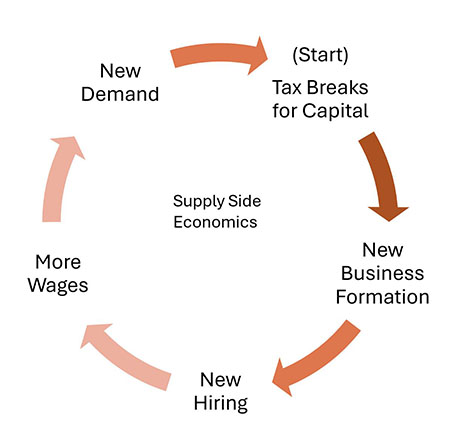
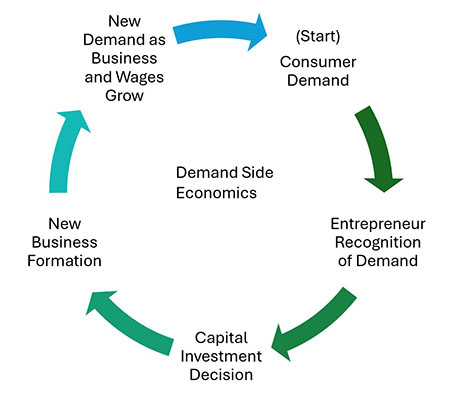
The problem with supply side economics, besides the greed, is that it misses the fundamental notion of why businesses are formed. They are formed from customer demand that already exists. It does not come from some nebulous epiphany from a billionaire. With that Macro Econ 101 lesson over, let’s move on to what we want to do.
Here is our plan:
1. Inform the public about the need to shift from a supply side economic model to a demand side economic model. Change the national discourse of how we view the economy, to only include the way it actually works.
2. Utilize anti-trust law to break apart large monopolistic businesses. This will lower prices by having more competition in the market.
3. Revamp government agencies like the Consumer Financial Protection Bureau. Use those agencies to go after bad businesses that are hurting consumers.
4. Strike trade deals with other nations for life’s basic goods, so that the cost living is more affordable.
5. Start a new program in the Small Business Administration to give capital to new businesses that choose to form a worker owned cooperative. We really want to see more democracy in the workplace.
6. Constrain private equity’s ability to wreck businesses for profit.
7. Crackdown on financial crimes.
8. Give citizens a way to refinance high interest debt through the federal government, at significantly below market rates.
9. Cap interest rates on credit cards at 10% over inflation.
10. Make student loans dischargeable in bankruptcy, as a prelude to other elimination efforts that may take longer.
11. Deemphasize GDP, equity market gains, and other capital class metrics of economic success. Replace them with metrics that indicate the quality of life for citizens. The economy should not be solely focused on what makes the cash register ring.
12. Punish white collar crimes more severely, and pass legislation to pierce the corporate veil of liability more easily.
13. Re-enact Glass-Steagall, a critical banking regulation that came out of the Great Depression for good reason.
14. Disallow for profit healthcare providers and insurers.
15. Disallow companies from performing share buybacks. This used to be illegal for good reason.
16. Start and maintain a federal jobs program to rebuild the nation.
17. Pass legislation to curb junk fees and overdraft fees.
18. Close tax loop holes and deductions for businesses that are against the public good.
19. Enact our housing, taxation and other economically relevant plans. (See other policy sections)
20. End the tariffs. Give that control back to congress.
21. End crony capitalism by severing the links between businesses and politicians.
22. Have a smart and humane temporary visa system for migrant farm workers.
23. Increase the minimum wage to a livable wage ($15-$17/hr.) and have it automatically increase annually with inflation data.
24. Nationalize relevant and critical sections of our economy.
25. Bolster unionization efforts and laws. Crackdown on businesses that break the law.
26. Adjust fines and penalties to allow them to exceed the profit made from the unlawful actions of businesses. It should be a significant penalty, not a cost of doing business.
27. In extreme cases, for those businesses that commit widespread and egregious crimes, owners will lose their ownership rights. The business will then be put under the control of the government until such time as it has fully completed restitution and then shall be dissolved.
28. Make pension liabilities no longer dischargeable in bankruptcy.
29. Crack down on wage theft and invoke steep penalties for offenders.
30. End no bid government contracts.
We’ll stop at 30, but you get the idea. Laws and policies that help hard working Americans achieve financial stability is what we want. The endless grifter economy has to stop permanently and we’re going to do it.
Frequently Asked Questions
Hasn’t America done great with supply side economics, why change it ?
No. Most average Americans know something is wrong with the economy, living here feels harder than ever. These crazy economic policies are why everything feels like a grift.
Why change how we look at the economy, don’t the old data points show the most important stats?
We would say no. The economy can be measured many ways. GDP for instance, is notoriously known for including in it very bad things for people making it grow. For instance, if you get sick and spend money at the doctor, that’s GDP stimulative.
Won’t increasing the minimum wage put some places out of business?
Yes, but if that business needed to pay people starvation wages to be profitable, it shouldn’t have existed in the first place. No one should work 40 hours a week and still not make it in the richest country on the face of the planet. People over profit, always!
Aren’t unions bad for business?
No. They are needed to keep the power balance between employer and employee even. We like to point to Germany’s success with unionization as a model of how things should be run. Alternatively, we think worker owned cooperatives are an even better solution. Democracy in the workplace.